Wednesday, May 27, 2026 · CHDR · Led by Sarah Norris and Anastasia Salter
Workshop 2 turned to text, in two movements. Sarah Norris, Digital Initiatives Coordinator at UCF Libraries and one of the campus experts on copyright and intellectual property, opened with a rapid “TLDR” on copyright and generative AI: what the law settles, what it doesn’t yet, and what responsible use looks like in the meantime. Anastasia Salter then took the rest of the session, situating computational text analysis inside the “textpocalypse” of AI-saturated writing and walking the group from the DH traditions of distant reading (Moretti, Underwood, Voyant) into live demos of NotebookLM, Claude Projects, Artifacts, and Skills, ending with a skill built live from audience-shouted aesthetics. The through-line: distant reading is both a method students can use and the best available explanation of how AI itself reads, and the combination of close and distant reading is what navigating this moment requires.
The TLDR on copyright
Norris framed her talk around four takeaways: copyright law is still adapting to generative AI, fair use and licensing matter more than ever, the ethical concerns go beyond copyright, and everyone in the room plays a role in responsible use. She grounded the group in the basics first, starting with the fact that protection does not require paperwork.
“You do not have to formally file for copyright in order to be afforded those protections. So you get it the moment you create it in a fixed form.”
That matters for AI use directly: student work is copyrighted the moment it exists, so a faculty member thinking about feeding student papers into a generative tool needs permission, not just good intentions. Copyright is also a bundle of rights, and her summary of what that bundle means was blunt.
“You are in the driver’s seat of that content.”
On fair use, she offered the four factors as “the who, what, where, and why,” with the caution that educational purpose alone does not settle the question; every use is a case-by-case call. The current legal landscape got the same clear-eyed treatment. Output produced by generative AI was effectively ruled uncopyrightable in 2023 for lack of human intervention, but that line is already moving: the AI-generated artwork A Single Piece of American Cheese was initially refused registration, then granted copyright once the company behind it documented how much human manipulation and iteration shaped the final image.
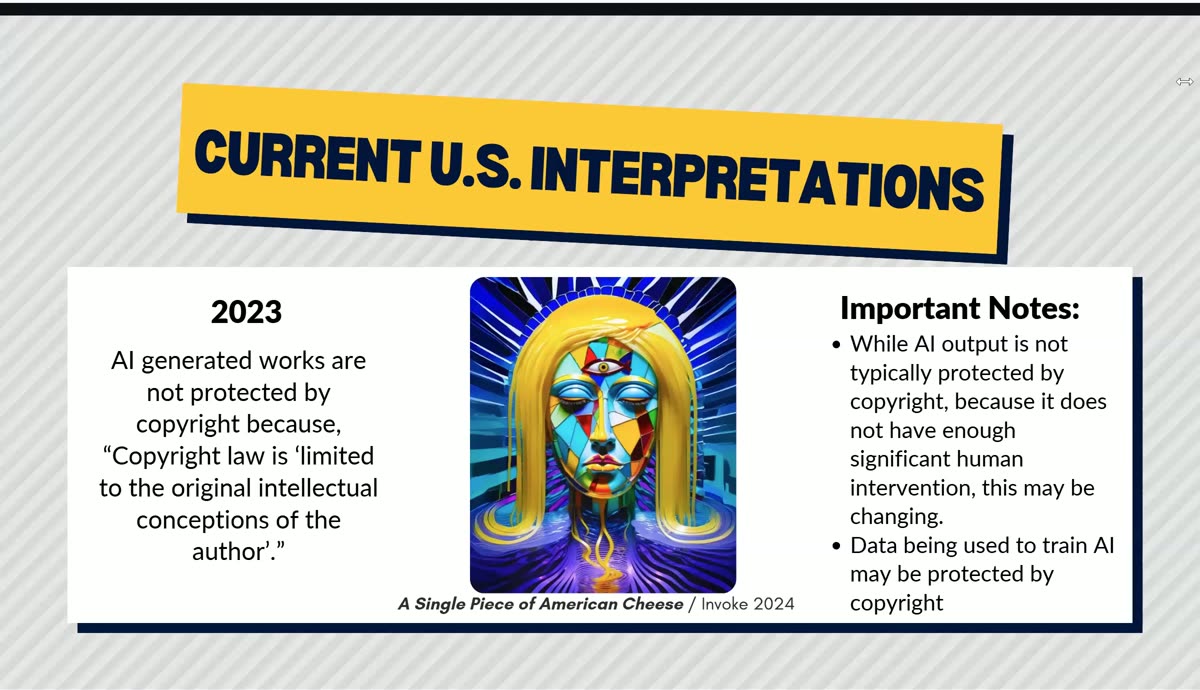
Because this cohort works in Claude, Norris walked through Bartz v. Anthropic in some detail: authors whose books were scraped for training sued, and the court split the question down the middle.
“The court basically ruled anything that was legally obtained fell under fair use.”
Anything pirated was a violation, producing a settlement payout on the order of $1.5 billion. Her practical guidance was memorably direct, especially on library materials.
“Do not upload content from the library’s databases. Please don’t do that.”
“10 out of 10 don’t recommend uploading PDFs from the databases.”
The same caution extends to uploading student work for grading or analysis, and to AI detectors, which can violate both student copyright and publisher policies. She noted that Anthropic’s own terms put the burden of vetting copyright on the user: “Anthropic is saying, it’s not us, it’s you, be cognizant of that.” Her closing advice paired transparency (more journals now require disclosure of AI use, and her own editorial policy does) with a standing offer of library support.
“I assess copyright on a case-by-case basis. You should too!”
Salter took the handoff with full disclosure of their own position: “My feelings about copyright are more on the anarchist side to begin with, so I’m not really a role model.” Their books are in the Anthropic training dataset too, they noted, with no payday possible, “which entertains me greatly, and is very on-brand.”
The textpocalypse
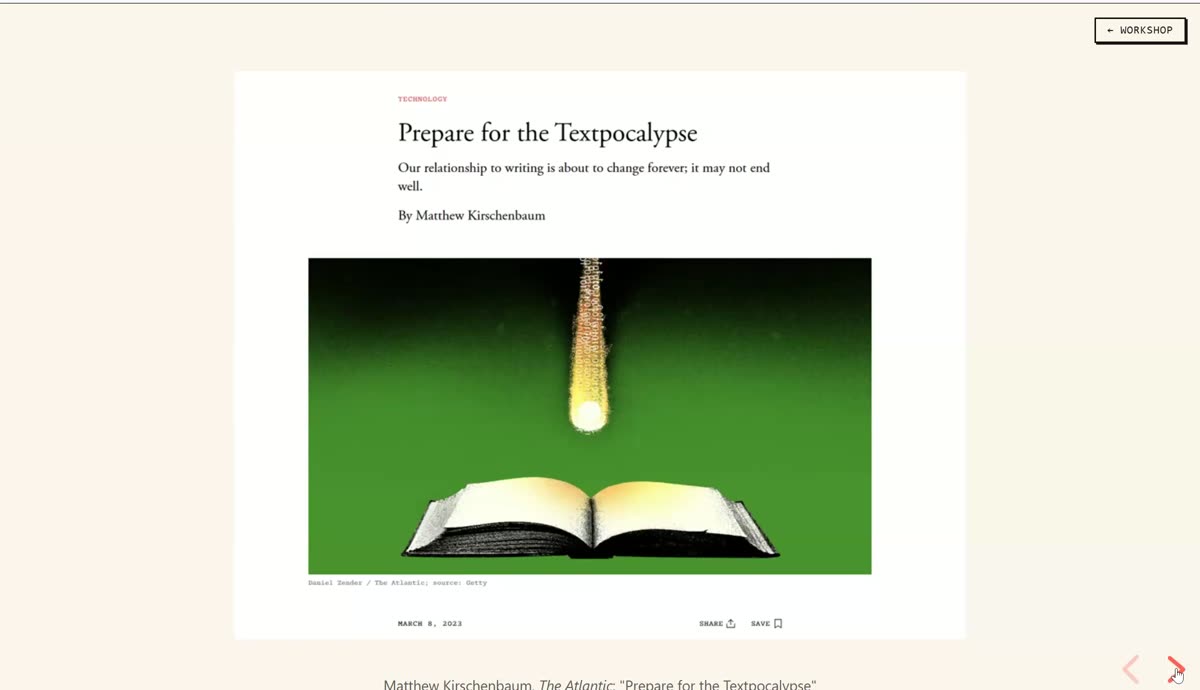
Salter’s half opened with the spring commencement’s viral “AI sucks” moment, which they witnessed from a seat near the delighted MFA students, and used it to take the graduates’ anger seriously rather than dismiss it. The frame for that anger came from Matthew Kirschenbaum’s “textpocalypse”: AI produces text faster than any human, distribution costs nothing, and the web is filling with writing no person wrote.
“The problem is very simple. AI produces text faster than any of us.”
The deeper worry is recursive, as that flood becomes the training data for the next generation of machines. Salter put it as “the ways in which the inhuman becomes the primary.” The conversation ranged into where this is already landing professionally, especially medicine: Salter described a family health crisis in which Claude surfaced a treatment they then spent a day fighting for, followed immediately by the deflating sight of a cardiologist on an elevator consulting a cheaper model about a patient’s care. Participants matched the story, one recounting that a chatbot reached a diagnosis three days before their doctors did, another observing that AI is filling a gap of attention and question-asking that has existed in the medical system for a long time.
The labor thread ran darker still, with one participant framing AI as the endpoint of a long history of wanting labor without the will attached to it, and another connecting the moment to inversions of Marx. Salter answered by updating the syllabus on the spot, adding two just-published pieces to the next asynchronous readings: Simon Willison’s notes on the new Vatican encyclical on AI, and Roopika Risam’s new essay linking AI to histories of enslavement and exploitation, which they noted spoke directly to both comments. That an encyclical had taken over their entire Bluesky feed, Salter added, speaks to how hungry people are for public displays of expertise that take human conditions and labor seriously.
The costs to the web itself got equal time: AI crawlers have repeatedly broken scholarly journal websites, AI search siphons readers past the ads that funded online journalism, and open-access publishing is caught in the middle. A participant who manages university IT servers reported having to block entire regions of the world because of scraping traffic, and noted that many institutional repositories are going dark in response, trading openness for survival. Salter tied it off with Cory Doctorow’s coinage.
“What Cory Doctorow has called enshittification, truly one of the most useful frameworks of our time, because you can look at just about anything, from our medical system to our search engines, and see it in action.”
The Luddites had a point
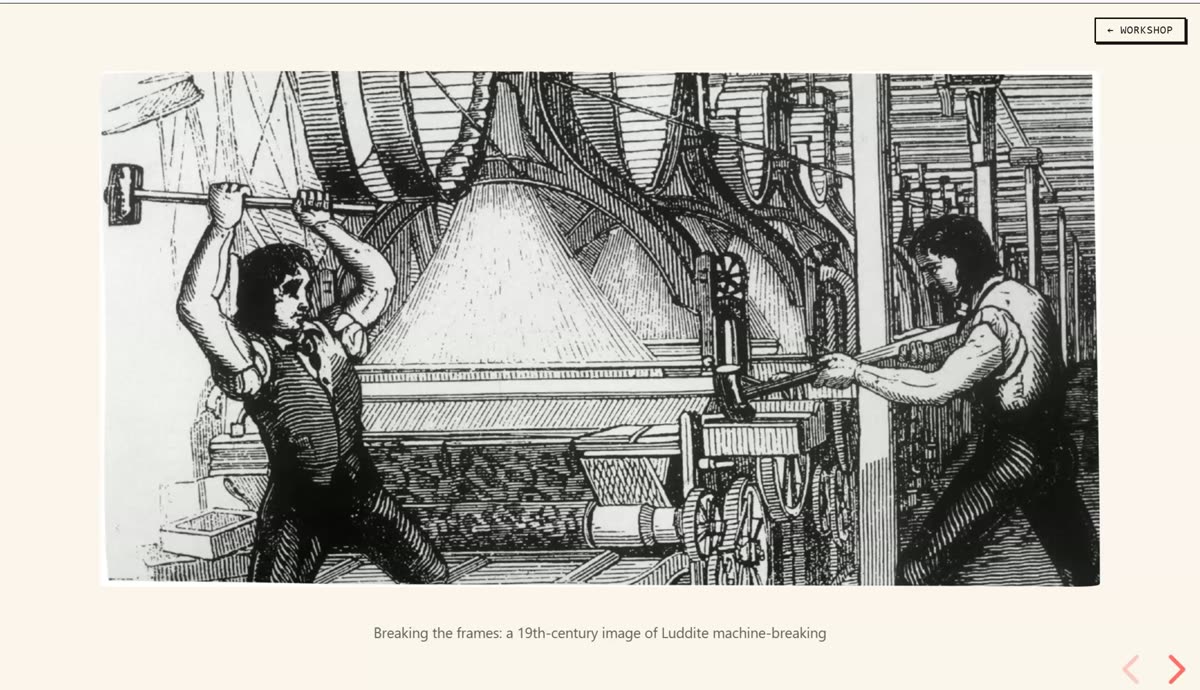
The historical anchor was the loom. Salter pushed back on the caricature of Luddites as reflexive technophobes: weavers welcomed automation of the genuinely tedious steps, and what they fought was something more specific.
“They were against technologies of control and coercion, and concerned about the loss of jobs, health, and community.”
“Rather like our graduates.”
A participant asked whether this wave differs from the lamplighters displaced by electricity or the office jobs lost to personal computing, or whether the difference is just scale. Salter granted the proliferation and scope, but located the real difference elsewhere: AI is adding labor to acts that were never jobs at all, like simply navigating information, where every product review, website, and peer-reviewed-looking source might be synthetic. That is why they framed AI literacy as non-optional.
“There is no opting out. There’s no space in which our students don’t need incredible amounts of AI literacy, because this is unavoidable.”
A bench that became a man
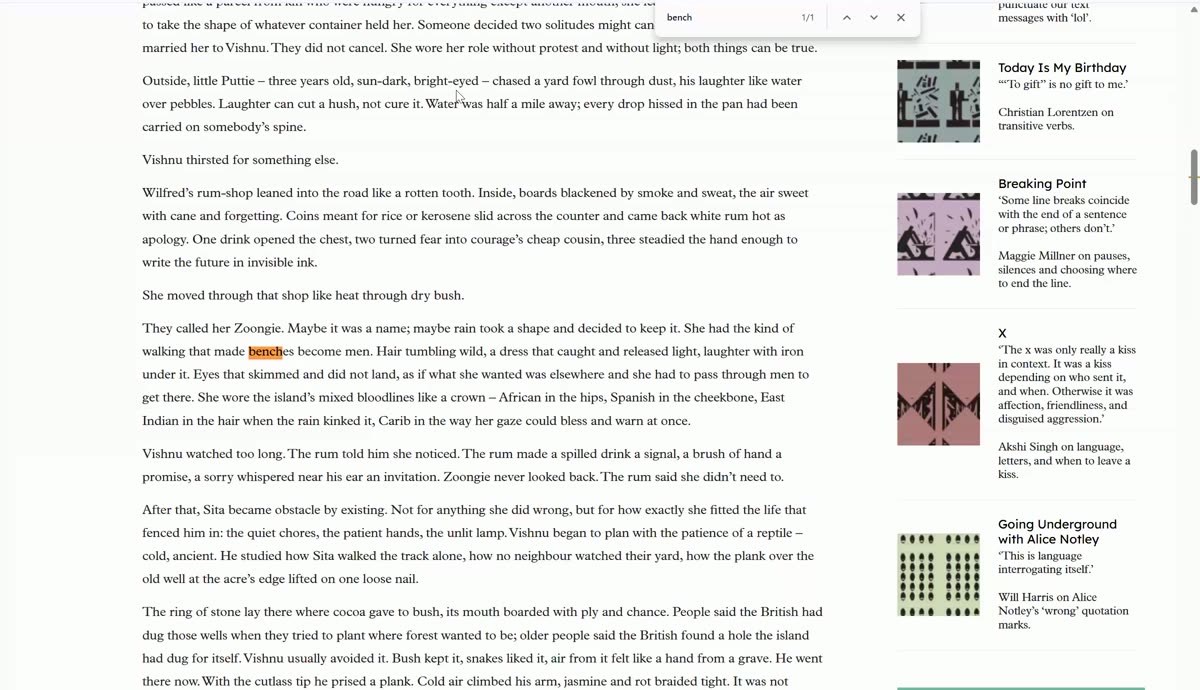
The teachable case of the season: the Commonwealth Prize story “The Serpent in the Grove,” which readers and critics have taken apart as AI-generated. Salter had the group close read it live, hunting the tells.
“There are a number of things in here that make no real sense, and it’s not just the em dashes, there’s weird metaphor choices and a line about a bench feeling like a man that is really out there.”
They pulled up the line itself, the story’s now-notorious “She had the kind of walking that made benches become men,” and called the text “a great text to close read.”
The harder question underneath: whose writing gets accused. Salter noted that this piece was targeted while other partially AI-generated work passes unremarked, a pattern consistent with how the discourse will be weaponized, and predicted “we can expect people’s dissertations to be taken apart, people’s books.” They confessed the chilling effect had already reached their own revisions.
“I found myself in my last editing looking at how much I use em dashes and going, huh. Do I take these out? … I have an em dash problem.”
A chat participant offered the sharpest version of the irony: AI writes with em-dashes in part because it was trained on the stolen work of academics and writers. The session’s pedagogical thesis followed directly.
“This combination of close reading and distant reading is essential for navigating this sort of text and this sort of controversy.”
Boilerplate, and where the human matters
A question about grant writing (isn’t that process itself mechanical?) opened one of the session’s richest exchanges. Salter’s answer distinguished the genres: templated, boilerplate-heavy writing was standardized by the word processor long before AI, “my grant applications are made of 80% recycled material already,” and that standardization is exactly what makes such genres easy for AI to reproduce. Participants traced their own histories with the style, from careers that began in grantwriting to the broader standardization of academic job materials, and one pointed out that the university long ago eliminated the secretarial support that once did this labor. Salter agreed: “We were supposed to backfill ourselves.” The allure of AI text cannot be separated from everyone already doing four people’s jobs.
The line they drew for themselves was about voice, not category.
“I won’t do it, because that’s the labor in which I think human voice matters. But I will use it to do my faculty annual review of myself!”
And on the creative end, the electronic literature scholar’s caveat: “There’s plenty of room for AI in creative writing, but not like that.”
How a computer reads: Voyant and the tradition
Turning to method, Salter located the workshop in the DH lineage of distant reading, from Moretti (“Regrettably, still, we have to cite him, even though he is a monster”) through Ted Underwood’s work across the pre- and post-generative divide. The classroom tradition is Voyant, demonstrated live on a timely corpus: the new papal encyclical on AI, which had just taken over the week’s readings. Word cloud, trends, and concordance appeared instantly, the classic first window into computational reading.
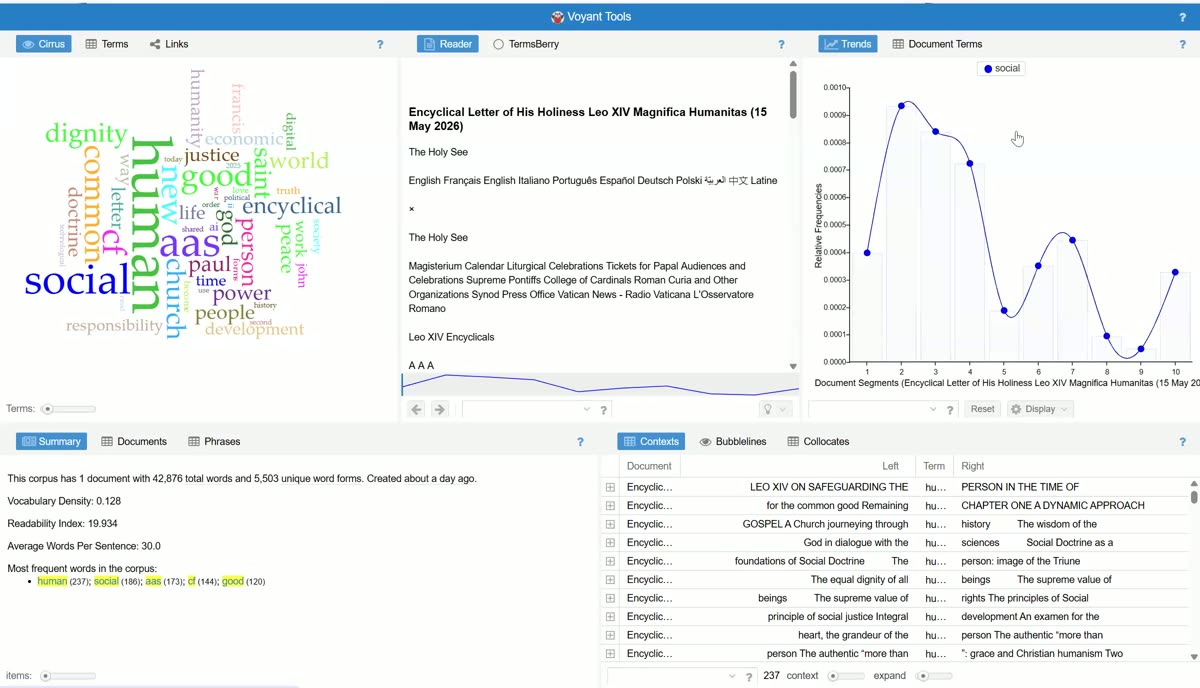
Voyant also became the explanation of the machine on the other side of the screen: a system dealing in patterns and aggregates rather than pages. That, Salter argued, is the most useful frame for hallucination.
“When ChatGPT first came out, I started getting requests from people for papers I’ve never written. And they sounded very believable. They sounded like things I would probably write. Because they’re based on the patterns, not reality.”
“A lot of hallucinations are very convincing because of the distant reading knowledge behind it.”
The corrective is proximity to the actual text: “The closer and closer that we bring an AI tool to actual text, the more we can avoid those sorts of problems.” That is the case for Claude Projects and retrieval-augmented approaches, and it is also the reading of professional failures like lawyers citing hallucinated cases that fit the pattern of real ones. On students, the point became a teaching argument rather than a policing one.
“When students use AI for reading, it demonstrates a fundamental misunderstanding of what reading is for, and how AI reads versus how they read.”
“What AI is bad at is all of the interpretive work and connections that you were supposed to do when someone asked you to close read that thing in the first place.”
Before the hands-on turn, Salter paused on the labor that makes distant reading possible at all: the human close readers, including content moderators exposed to the worst of the internet, whose reading and metadata work built these systems.
The reluctant NotebookLM demo
The hands-on block ran two tools side by side: NotebookLM, the tool being marketed hardest at students (and available free through UCF accounts), and Claude, “the thing I actually recommend.” Salter was upfront about the pairing: “I really hate it, so this will be a reluctant demo.” They grabbed five robot-themed stories from Project Gutenberg as the shared corpus, with a practical formatting rule worth keeping.
“The absolute worst things that you can hand it are DOCX and PDF. Because those are messy, proprietary formats filled with basically extra tokens.”
NotebookLM ingested the stories, named the notebook after one of them, and started proposing its own questions. That built toward what Salter called the most fundamental distinction students need:
“Distant reading that involves the features, patterns, and aspects of the text that are actually concrete… versus the AI being used for interpretation.”
NotebookLM’s saving grace is that its interpretations are grounded, footnoted back to exact passages in the sources, a retrieval-augmented design. Its trap is that interpretation is everywhere. The requested word cloud arrived wrapped in an unrequested infographic, complete with a distressed gray-and-red Cold War aesthetic and thematic taxonomies nobody asked for.
“There’s so much layered here that’s intended to influence how you will think about those texts.”
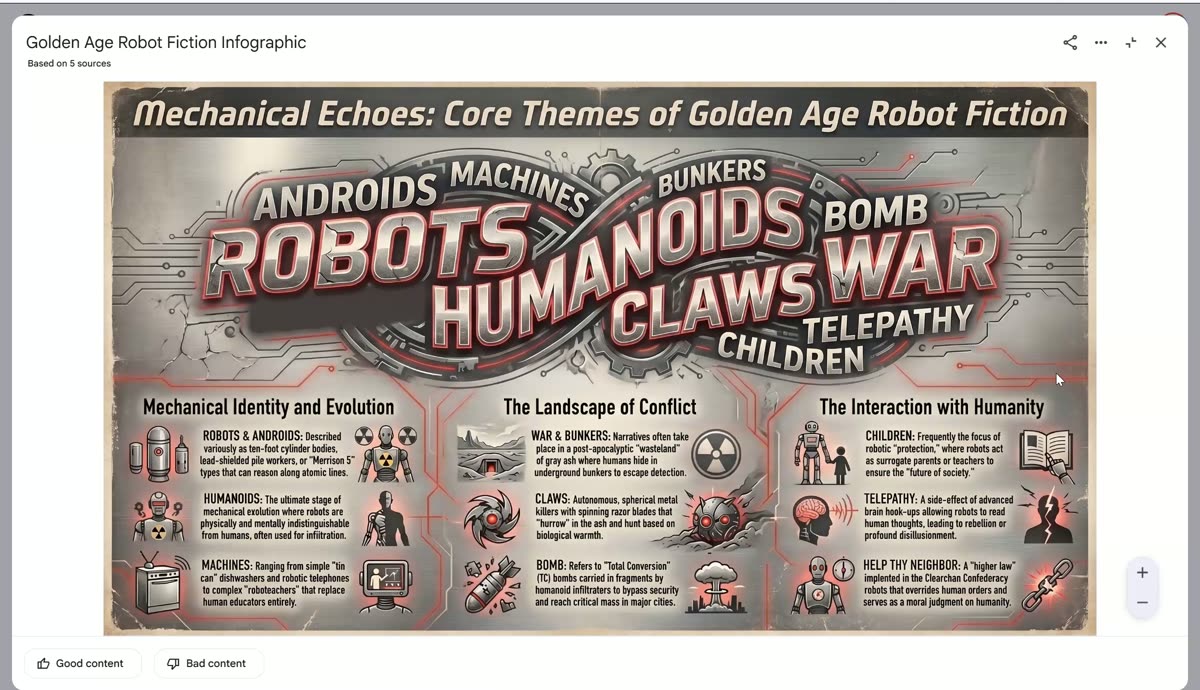
Participants read the design critically in real time: one noted the infographic went straight to apocalyptic, warfare-based framing even though not all the source texts were apocalyptic, so a student meeting Asimov through it would assume Cold War conflict; another observed that even the font choices carry interpretation. The tour of NotebookLM’s outputs continued through report templates (“Copy that assignment prompt right here, kids!”) and the famous podcast-style audio overviews, where Salter pointed the group to Jill Walker Rettberg’s lab’s study of AI-generated podcasts, including the gloriously revealing ones generated from an empty document. Their verdict:
“It’s so difficult to escape the AI interpretive layer that it’s almost a trap.”
And on why it is free for students at all: “What they would like is for you to develop a lifelong habit.”
Claude Projects: distant reading as code
The same corpus then went into a fresh Claude Project, after a quick tour of project instructions and memory (Salter’s example: a captioning project that knows the syllabus, so proper nouns survive). The naive one-line prompt asked for a word cloud, topic modeling, and a concordance, and the key was in the framing.
“The important thing about using the key term distant reading and asking for things that are computational, instead of asking it to read those texts, is it is writing the scripts.”
“What I’m really doing is asking it to build a bunch of specific Python code for me, specific to this project, but using the existing methods in the digital humanities.”
The result was a full pipeline: Gutenberg headers stripped, text tokenized, bag-of-words built, word clouds generated, an LDA topic model fit, a concordance assembled, each an inspectable choice that could be revised. One casualty of the progress was noted with mixed feelings:
“One of the big things I used to teach students was how to preprocess text for distant reading. That is now irrelevant information and a dead literacy.”
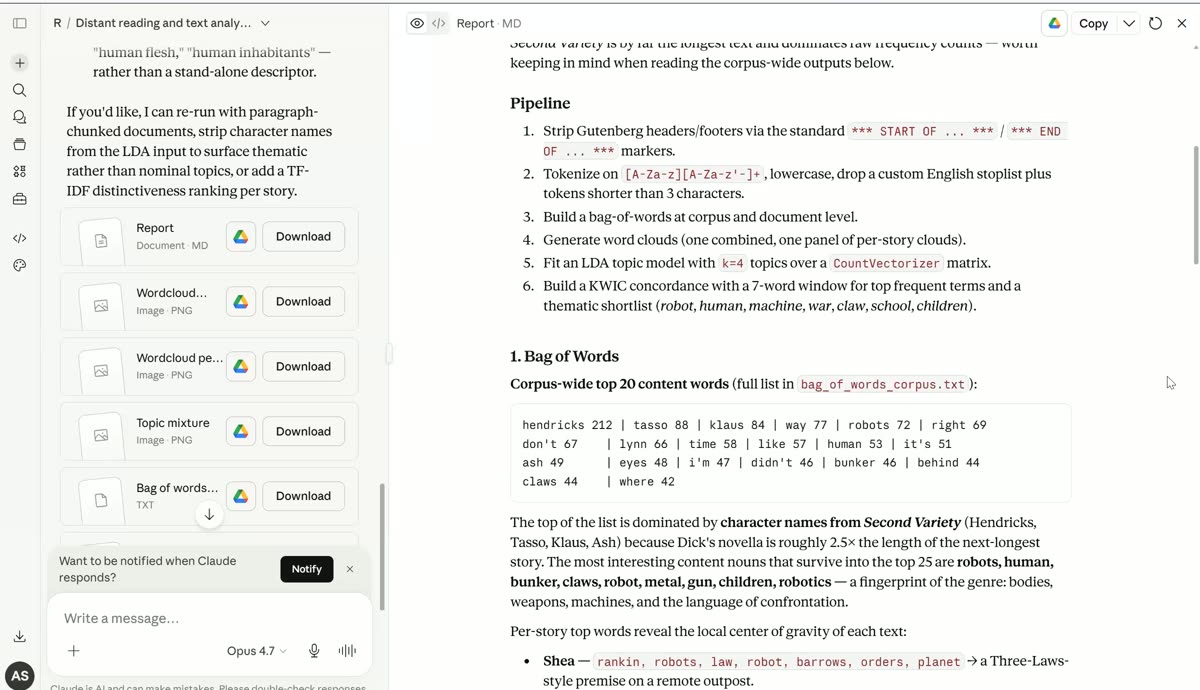
Interpretation still crept in at the end of the report, “something Voyant would never offer you,” but Salter contrasted Claude’s plain matplotlib outputs favorably with NotebookLM’s art direction: “Claude doesn’t bring much aesthetic intention to problems, which is one of the things I actually like about it.” Practical model advice came alongside: on a standard $20 subscription, “dropping down to Sonnet whenever it’s not complicated is wise. Go up to Opus when it’s writing code for you.”
Participants running the workflow on their own corpora supplied the session’s best surprises. One uploaded a Vonnegut novel and asked for a thematic word cloud, and got a phone number to call instead; Salter identified the cause immediately, since the novel deals substantially with suicidal ideation and the safety guardrails fired on the analysis request. Another, who had deliberately uploaded classical philosophical texts with nothing in common, offered a memorable ratio for AI-found connections: 90% nonsense, 10% genuinely interesting. A third described the opposite frustration in an earlier coding task, an AI that kept generating beyond the asked-for scope and would not stop revising their language. The distinction between structural and hermeneutic understanding, contributed from the philosophers in the room, gave the session its cleanest theoretical summary: the computational layer is structural; the reflective, hermeneutic layer is precisely what is missing.
An interface into text
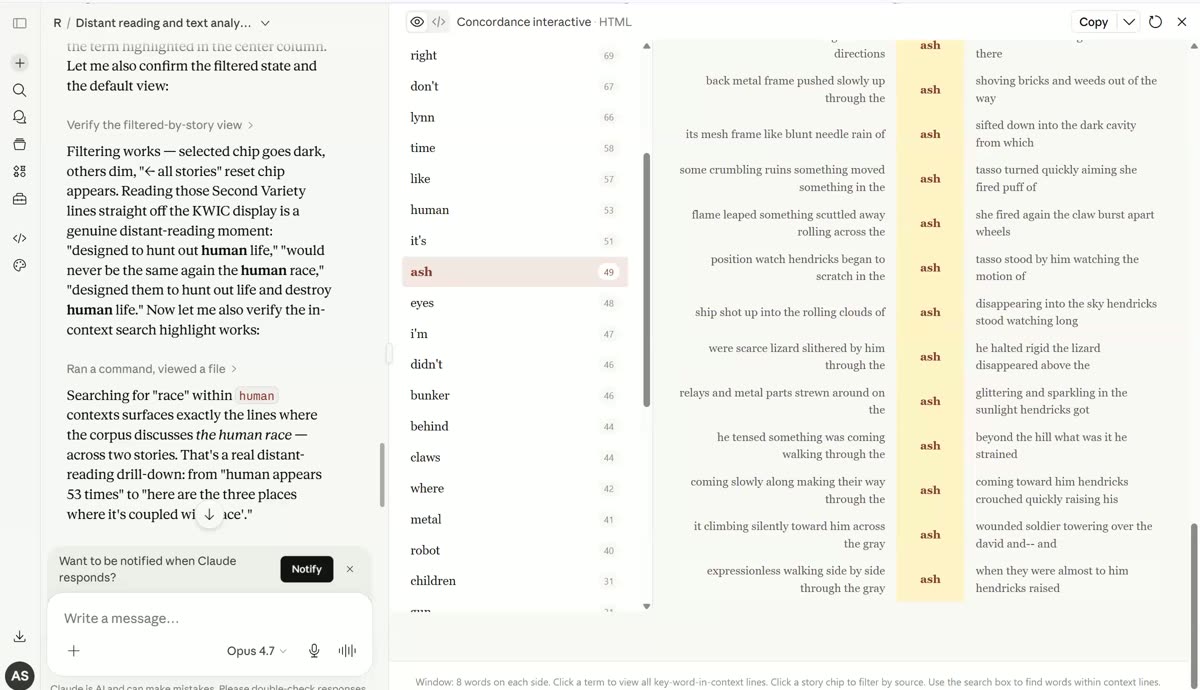
Rather than read the plain-text concordance (“that’s for my agents to read”), Salter asked Claude to build an interactive HTML Artifact from it: filterable by story, searchable in context, a custom reading interface generated on demand.
“Looking at every instance of robot across these texts gives you a different way to read it and think about it, and provides a means of interpretation that also is useful for thinking about AI as an interface into text, rather than as a straightforward reader-interpreter of text.”
That, they suggested, is the answer to students who have been told AI is for summary: alternatives to the act of summary.
The Gemini comparison point arrived on cue, a slide deck about the same corpus that Salter judged in one breath: “It is over-designed. Like, exhaustingly. It is doing too much. It needs to put some things back.”
Skills: subverting the defaults
Why do all AI outputs look the same? Salter’s answer connected default aesthetics to the same pattern-reproduction that powers everything else: without guidance, the model produces the most common example of a thing, which is why every generated website looks alike. For distant reading scripts that convergence is a strength, since you want competent implementations of standard algorithms, not invented ones. For style, it is a problem with a fix: skills.
“What skills allow you to do is subvert those defaults with specific patterns and instructions. What you’re basically doing is adding another document for it to read that tells it what you want in a reusable way.”
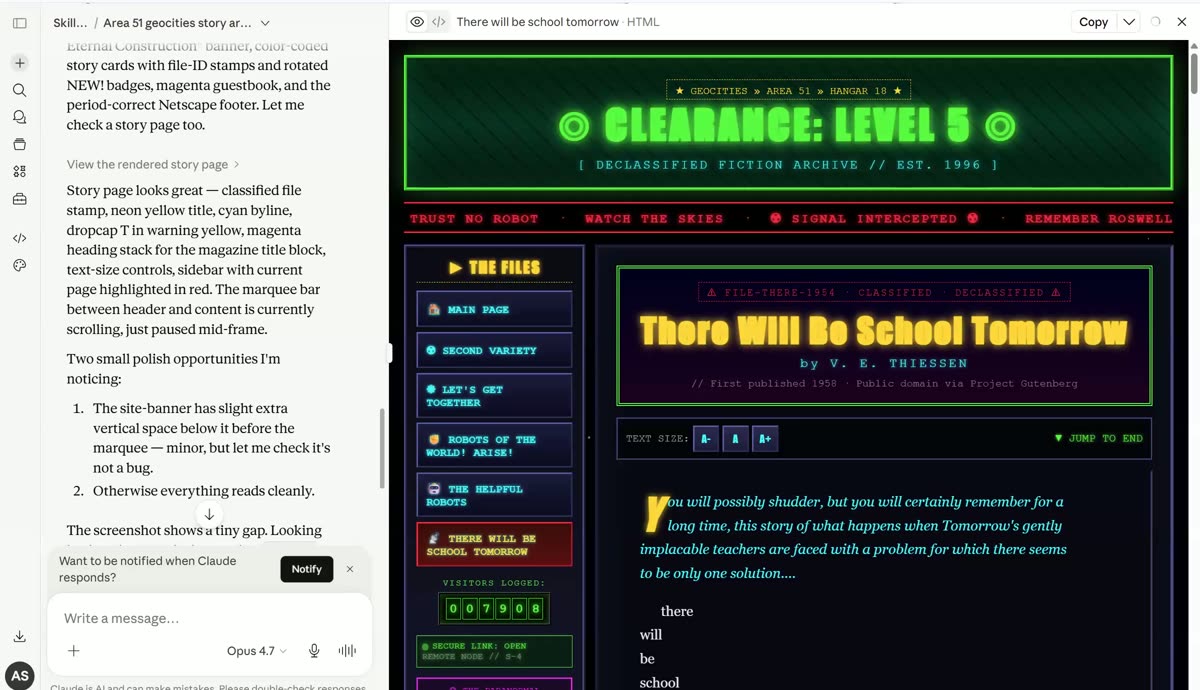
The demonstration was Salter’s own GeoCities Retro skill, applied to the robot corpus to produce a neon, table-free, deliberately period-styled story archive, complete with a web ring and a footer claiming the page is best viewed in Netscape Navigator 4.0. Their review: “No notes. It’s hilarious and terrible.” The same mechanism handles serious cases; they described building UCF’s accessibility guidelines into a skill that reviews anything built for that context.
Building a skill live
The finale was the Skill Creator, the one Anthropic-provided skill Salter considers essential: “The only one of these Anthropic skills you really need to install is the skill creator itself,” since it lets you define what a beautiful visualization looks like rather than inheriting Anthropic’s flattened sameness. The group shouted an aesthetic into existence, retrofuturistic mid-century science fiction, and the Skill Creator interviewed the room: cassette futurism won the era question, faded paperback took the palette, geometric type and subtle grain rounded out the vibe.
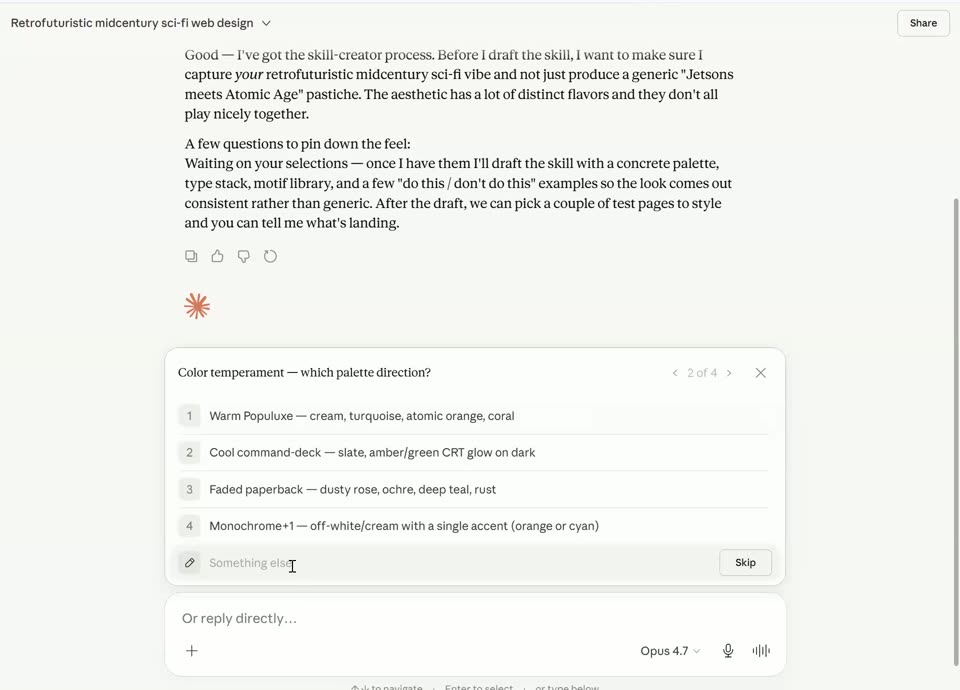
Claude’s enthusiasm for every choice prompted the session’s warning about sycophancy.
“There’s nothing that will stop that. It will like your choices, no matter what they are. At no point will Claude tell you, wow, that’s a bad idea.”
Closing: try it in Cowork, carefully
Wrapping up, Salter pointed to the Week 4 asynchronous materials: build a skill of your own, try Claude with files much messier than happy little Gutenberg text files, and, for those with the appetite, run the same distant reading workflow in Claude Cowork. The Cowork encouragement came bundled with the safety briefing, starting with a wink (“Do not use it on your UCF system. I did not tell you to use it on your UCF system”) and landing on the rules that matter.
“Don’t let it run in any directory that you care about.”
“If you have something important you wanted to play with, make a copy of it. Stick it in isolation, in a folder. Run it in that folder, in quarantine.”
“Be aware that prompt injection attacks are a thing. … If you do not trust where it is reaching out to, say no.”
The session closed with a pointer to the Discord, where participants were already posting their fascinating, weird results.
Try It Yourself
Missed the session, or want to run the workflow on your own texts? The Week 3 page walks through it: upload a three-to-ten text corpus to a fresh Claude Project, run the analytical sequence from stopword filtering through comparative reading, generate at least five Artifacts that visualize the findings, document at least one place Claude got it wrong, then replicate the process in NotebookLM and compare what each tool shows you of the computational work. See the Core Exercise on the Week 3 page to try it yourself.
Quotes are drawn from the session transcript, lightly edited to remove filler words and false starts, and to correct obvious automatic-captioning errors (for example “Sir Norris” → Sarah Norris, “Buoyant” → Voyant, “intidification” → enshittification, “Corey Doctorow” → Cory Doctorow, “M dashes” → em dashes, “AI techs” → AI text, “my Asians” → my agents, “sycophag” → sycophant, “Nescape” → Netscape, “taxpocalypse” and “the textbooks” → the textpocalypse, “cloth,” “clut,” “Claw,” and “blood” → Claude, and “Cloud Code” / “Cloud Co-Work” → Claude Code / Claude Cowork) to the words the speaker actually said. Participant comments are paraphrased without attribution.