Week 10 Interdisciplinarity and the Academic Job Market
ENG 6813 · Salter & Stanfill
The Value of a DH Degree
Hopwood & Roberts — what the credential is grounded in
“The value of DH degrees is ultimately grounded in interdisciplinary training, exposure to a pedagogy rooted in the classroom and hands-on skill building, and preparation for a variety of professional careers.”
— Hopwood & Roberts
This is true of the T&T and DHAI programs you’re enrolled in.
But it’s also true of the kind of DH courses this class is helping you work toward teaching.
Balancing the Digital and the Humanities
Hopwood & Roberts — inquiry first, tools in service of it
DH courses prepare “students to work in and with emerging technologies, while foregrounding DH as interpretive knowledge work.”
Alongside the technical, “a robust training in DH must foreground humanities inquiry within coursework and research.”
Building stuff is cool and fun — but understanding why to build it and how is where the work happens, especially when the building is (to whatever extent) offloaded.
Humanities inquiry first; tools in service of it.
DH in the Humanities Curriculum
Hopwood & Roberts — where does your course fit?
Where does your course fit? Will students already have technical expertise coming in?
In most cases, no: “most students in their undergraduate careers … might only get to take a course or two with DH content or work on a project with a DH-engaged faculty member.”
DH and Career Readiness
Hopwood & Roberts — digital literacies in the labor market
They recommend “discussing how traditional humanities degrees and digital literacies can be spoken of (and traded for compensation) in the labor market.”
“A perennial anxiety emerges among students, especially those with humanities backgrounds, that they are not learning enough coding” — AI can be a bridge for making technology projects, as coding becomes less necessary and this anxiety takes longer to disappear.
Some students “seek demonstrable technical training and skill sets that they can apply to their own research and careers, such as database design, coding, text mining or machine learning techniques, and geomapping.”
Meaningful Work vs. Exploited Labor
Hopwood & Roberts — the ethics of student projects
There’s a tension between giving students real, meaningful work to do and not exploiting their labor.
Ensure fair credit; consider labor requirements and conditions.
From the Degree to the Job Letter
Albakry — four pitfalls to avoid
Hopwood & Roberts started us thinking about the job market — now here’s the more brass-tacks version:
Show what guides your teaching practice; don’t namedrop theorists.
Use specific anecdotes and examples; don’t write in buzzwords.
It’s good to show your teaching provides options and range — but “learning styles” are debunked.
Beware of stereotyping low-income, first-generation, and other marginalized students; if you go there, do it with your own specific examples.
The Teaching Statement
Not always required — always useful
Teaching statements are not always a required job material.
If it’s not required, you’ll discuss these topics as part of your cover letter.
It’s sometimes called a “teaching philosophy,” but don’t let that fool you: it should still be evidence-based, not vibes-based.
Structuring the Statement
A workable shape
Start with an anecdote as a hook.
Provide a framework for your teaching emphasis.
Offer specific examples of things you do, and how they demonstrate your approach.
If you have them, include citations of sources or methods that inform your teaching.
Conclude by indicating how you’ll bring all that to the teaching responsibilities of this particular role and institution.
Like the reading from earlier in the semester, Cohen flags the potentials of AI–knowledge institution collaboration:
AI gets better underlying data.
Knowledge institutions get better ways to explore and work with their collections.
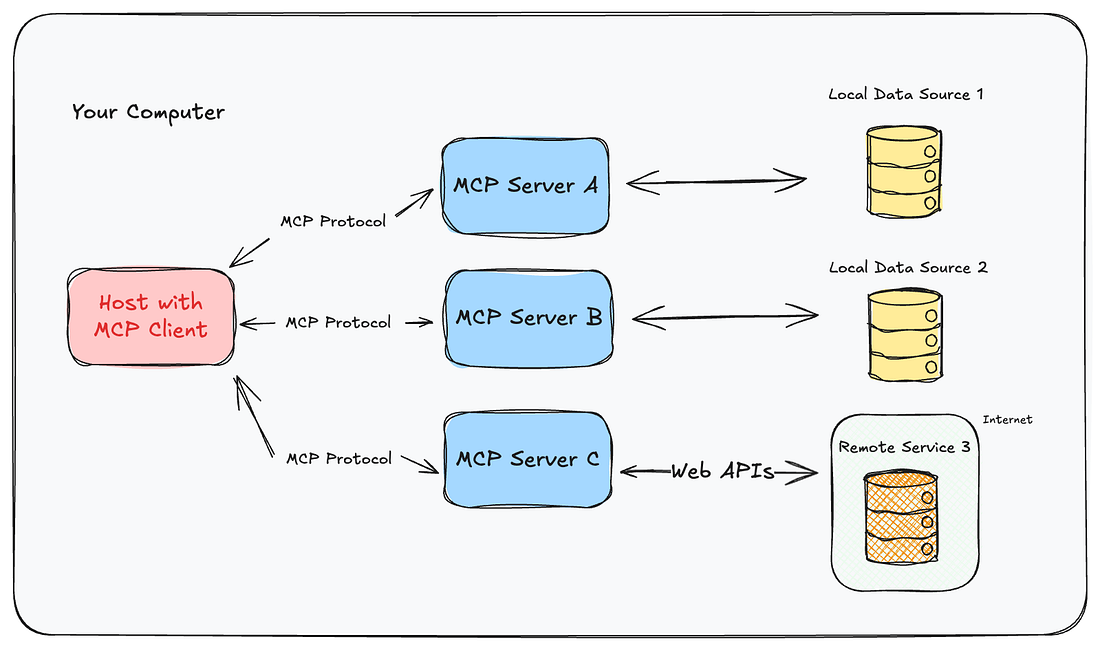
Loosely Coupled, Concretely: MCP
Cohen — configurable access, institutional control
One way to concretely do AI–knowledge institution collaboration is through MCP, which allows any organization to provide access to their collections in specific, configurable ways.
MCP allows institutions to maintain control over what is accessible, in what format, and to what degree — such as metadata only, not full text, encouraging users to visit the source itself.
Pro: Local models don’t present the same extraction or data-privacy problems, and they use fewer resources.
Con: This approach may not be feasible for small institutions with few resources.
Con: The improvement of AI outputs is only as good as the quality and variety of the knowledge institution’s corpus.
Con: Knowledge institutions are often extractive too!
This Week
No discussion post this week. Focus on completing your Course Syllabus.
Course Syllabus (200 points, due Sunday, July 19). A complete syllabus for a course you could teach, following an institutional template, incorporating at least one AI-integrated element.
Readings: Hopwood & Roberts, “What’s the Value of a Graduate Digital Humanities Degree?”; Albakry, “Writing a Strong Teaching Philosophy Statement in a Job Search” (Inside Higher Ed); Cohen, “AI and Libraries, Archives, and Museums, Loosely Coupled” (Humane Ingenuity).
See weeks/week-10.md on Canvas for the full guidelines and reading links.